
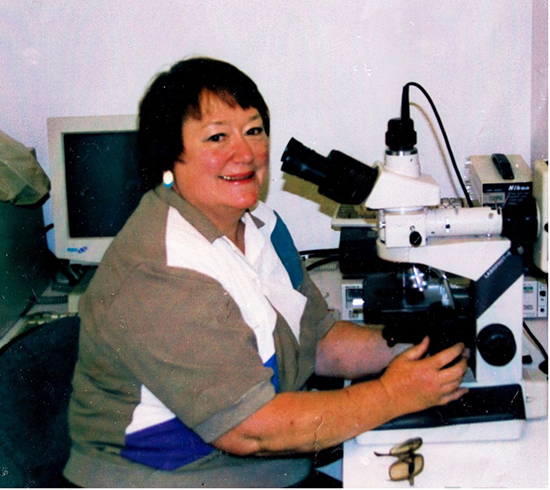
The international antinuclear antibody (ANA) community lost a remarkable pioneer with the passing of Carol Lynn Peebles on July 8, 2026. For more than two decades, Carol served as the chief technician in the laboratory of the late Professor Eng Meng Tan at the Scripps Research Institute, one of the most influential centers in the history of autoantibody and ANA research. During those years, the Tan laboratory trained a generation of scientists who would later become leaders in rheumatology, immunology, dermatology, and autoantibody diagnostics around the world. Many of the individuals who eventually became key contributors to the International Consensus on ANA Patterns (ICAP) received part of their formative training while working alongside Carol in Dr. Tan's laboratory.
Together with Professor Tan's vision and scientific leadership, Carol contributed a unique and equally valued presence in the laboratory, where former fellows often referred to her as its "heart," its "eyes," and the "ANA guru.” Her extraordinary expertise at the fluorescence microscope, her ability to recognize unusual HEp-2 cell staining patterns, and her meticulous biobanking of ‘interesting’ patient sera created opportunities for discoveries that shaped the ANA field for decades. Former trainees consistently recall that Carol taught them how to interpret ANA patterns, troubleshoot difficult assays, and appreciate the importance of careful observation. Numerous landmark autoantibody discoveries emerged from sera that Carol identified, collected, and maintained, including antibodies associated with centromere proteins, including CENP-A, -B and -F, DFS70, coilin, Ku, TROVE2/Ro60, TRIM21/Ro52, PCNA, and other key autoantigens.
Carol's impact extended far beyond her own impressive scholarly contributions. She was a co-author on more than 40 peer reviewed scientific publications spanning nearly five decades and was involved in seminal studies that helped define many of the ANA patterns and autoantibody systems recognized today. Yet her greatest legacy may be the countless investigators and technologists she trained, mentored, and supported. Former fellows repeatedly describe her as a generous teacher, a trusted advisor, and even a mother figure who helped launch successful scientific careers across North and South America, Europe, Asia, and the Middle East.
As ICAP continues its mission of standardizing and advancing ANA pattern recognition worldwide, it is fitting to recognize Carol Peebles as one of the field's most influential and, perhaps, underappreciated contributors. Her keen eye for pattern recognition, dedication to scientific excellence, and unwavering support of generations of trainees helped build much of the foundation upon which modern ANA diagnostics rest. The ANA community owes Carol a profound debt of gratitude, and her legacy will continue to be reflected in the discoveries, laboratories, and careers she helped make possible.
Carol was born and raised in Wichita, Kansas (USA) but, including a short stint in Denver, spent most of her adult life in the greater San Diego, California area.